
An Economic Criminology Analysis of the UK Insurance Market
Author: Noah Gilham
Abstract
This report evaluates the hypothesis that rebuilding consumer trust is a necessary condition for reducing the cost of opportunistic insurance fraud in the United Kingdom. Drawing on 2025–2026 consumer trust indices (Fairer Finance; Chartered Insurance Institute), industry fraud statistics (Association of British Insurers; Aviva), criminological theory, and behavioural science, it argues that opportunistic fraud – the exaggeration or fabrication of otherwise legitimate claims by ordinarily honest policyholders – is highly elastic and responsive to institutional conduct. Using Cressey’s Fraud Triangle and Tennyson’s work on consumer attitudes, the report locates the decisive variable in the rationalisation that low institutional trust makes available to consumers.
Drawing on the Dectech/Insurance Fraud Bureau randomised controlled trials, it shows that trust-oriented interventions can reduce dishonesty by over a third, with projected sector savings of between £132 million and £395 million annually. The report then maps practical levers – the FCA Consumer Duty, Explainable AI, usage-based insurance, and shared-value models such as Lemonade’s Giveback – and proposes a measurement framework linking trust indicators to fraud outcomes. Rebuilding trust emerges as a sustainable, cost-effective counter-fraud strategy.
1. Introduction: Institutional Trust and Policyholder Honesty
The relationship between the insurance sector and the consumer is inherently precarious, predicated on a mutual promise that exchanges immediate financial premiums for future, conditional protection. This social and financial contract is rooted in the legal principle of uberrima fides – utmost good faith. When this equilibrium is maintained, the insurance mechanism operates efficiently, distributing risk across populations and providing socioeconomic stability. However, the contemporary landscape of the United Kingdom’s insurance market reveals a concerning deterioration in this fundamental relationship. Rising premiums, opaque algorithmic decision-making, and protracted, adversarial claims processes have fostered a profound disconnect between policyholders and carriers. This erosion of confidence carries severe and – as this report sets out to demonstrate – quantifiable economic ramifications, most notably the rapid proliferation of opportunistic insurance fraud.
Opportunistic fraud – distinct from the highly organised, premeditated schemes perpetrated by criminal syndicates or “crash-for-cash” rings – occurs when otherwise law-abiding individuals fabricate, exaggerate, or omit information during the application or claims process to gain a financial advantage. Academic and industry analyses consistently demonstrate that the rationalisation of this behaviour is inextricably linked to the consumer’s perception of the insurer. When policyholders perceive insurance conglomerates as faceless entities prioritising profit margins and shareholder returns over fair consumer outcomes, the psychological and moral barriers to committing fraud erode markedly. Dishonesty is rationalised as a justifiable mechanism to “level the playing field”, to exact retribution for perceived slights, or to recoup premiums viewed as having been unfairly extracted during a period of macroeconomic hardship.
This report evaluates the core hypothesis that rebuilding trust between consumers and insurers is imperative to reducing the cost of opportunistic fraud. By drawing together consumer trust indices from 2025 and 2026, recent fraud-detection statistics from the Association of British Insurers (ABI) and major carriers, behavioural science research, and regulatory frameworks such as the Financial Conduct Authority (FCA) Consumer Duty, it forms a clearer picture of the mechanisms driving this erosion of trust. The report further outlines how transparency, procedural consistency, and human-centric technological innovation – particularly Explainable Artificial Intelligence (XAI) and behavioural nudging – can dismantle the cognitive rationalisations of fraud, ultimately restoring the economic sustainability and ethical integrity of the insurance sector.
2. Historical Context and Current Deterioration
To understand the correlation between trust and fraudulent behaviour, it is necessary to quantify the current state of consumer confidence and identify the structural fractures within the market. Historically, the insurance model relied on personal relationships, localised brokers, and a tangible sense of shared community risk. The digitisation and corporatisation of the industry, while driving operational efficiencies and scale, have inadvertently commoditised the product. Insurance is frequently purchased via aggregator websites on the basis of price alone, stripping away brand loyalty and the perception of mutual obligation.
This commoditisation has collided with severe macroeconomic headwinds. Inflationary pressures, supply-chain disruptions affecting repair costs, and regulatory shifts have forced insurers to implement substantial premium increases. Car insurance premiums, for example, surged dramatically throughout 2023 and 2024, creating a highly volatile consumer base that feels financially squeezed and unsupported by the institutions designed to protect them (Fairer Finance, 2025a; FCA, 2026a). When the cost of living reaches critical thresholds, the insurance premium is often viewed as a mandatory and extractive tax rather than a protective shield. It is within this climate of financial anxiety and institutional detachment that eroding trust translates into opportunistic fraud.
3. Quantifying the Trust Deficit: The 2025 UK Consumer Landscape
Recent polling and market research provide a granular view of the widespread disillusionment characterising the UK market. The data below indicates that, despite recent stabilisations in pricing, the psychological damage to the consumer–insurer relationship requires reparative intervention.
3.1 The Fairer Finance Trust in Insurance Index
Data from the Fairer Finance Trust in Insurance Index for Spring and Autumn 2025 illustrates a troubling trajectory. Following a six-year period of consistent improvement from 2017 to 2022, overall trust in the UK insurance sector regressed significantly, falling back to levels last observed in Autumn 2021 during the Spring 2025 polling (Fairer Finance, 2025a). This decline is particularly notable because it persisted despite recent reductions in previously inflated car premiums and the stabilisation of home insurance costs. The failure of price drops to immediately rehabilitate trust scores suggests that the damage inflicted on the consumer–insurer relationship is structural rather than purely transactional. While the Autumn 2025 index showed a marginal improvement across major sectors – bringing average claims satisfaction to 57.16% – the overarching trust deficit remains entrenched well below its 2017 peak (Fairer Finance, 2025b).
A deeper analysis of the Fairer Finance data reveals several drivers of distrust. The concept of “value for money” remains the primary friction point. While claims satisfaction has seen a gradual, albeit slow, recovery since bottoming out in Spring 2023, the broader perception of value continues to drag down overall trust (Fairer Finance, 2025a).
The data also exposes a claims gap. Trust is demonstrably higher among consumers who have actually navigated the claims process within the preceding three years. In the home insurance sector, for instance, 76% of claimants expressed satisfaction with their product’s value, compared with only 69% of non-claimants (Fairer Finance, 2025a). This discrepancy underscores a recurring industry failure: insurers struggle to demonstrate the intangible value of an active policy to customers who pay premiums without ever drawing upon the service. For the non-claimant, the policy feels like a sunk cost, breeding a latent resentment that can easily pivot into opportunistic behaviour should a minor incident occur.
The distribution channel also plays a decisive role in trust formation. Consumers purchasing policies via traditional advisors or brokers report the highest levels of trust, likely owing to the personalised guidance, human interaction, and perceived advocacy these intermediaries provide (Fairer Finance, 2025a). Conversely, consumers acquiring policies through price-comparison websites report the lowest trust levels. This demographic is often highly price-sensitive, resulting in transactional, transient relationships with brands where loyalty is virtually non-existent. In such environments the policyholder feels no moral obligation to the insurer, elevating the propensity for opportunistic fraud.
3.2 Comparative Brand Performance and Claims Satisfaction
The variance in trust across carriers highlights that operational practices directly influence consumer sentiment. Table 1 details the divergent performances of major UK brands in the Spring 2025 Fairer Finance Index, demonstrating that trust is highly dependent on corporate behaviour.
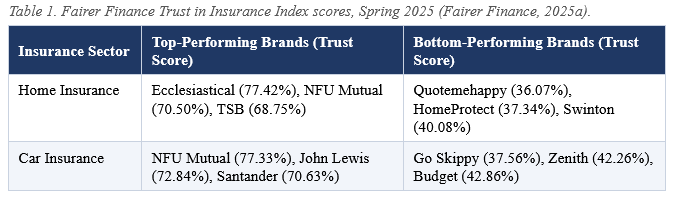
In terms of claims satisfaction, Bank of Scotland emerged as an industry leader in both home (73.16%) and car insurance (77.02%), while brands such as esure and Swinton consistently anchored the bottom of the rankings (Fairer Finance, 2025a). Travel insurance remains one of the most distrusted sectors, driven by consumer misunderstandings regarding complex coverage conditions, hidden exclusions, and rigid evidentiary requirements, which subsequently generate high volumes of Financial Ombudsman Service (FOS) complaints when claims are denied (Fairer Finance, 2025a).
3.3 The CII Public Trust Index: Deficits in “Fairness”
Corroborating the Fairer Finance data, the Chartered Insurance Institute (CII) Public Trust Index (published September 2025) offers a view of consumer expectations and the specific areas where the industry is failing to deliver. The CII data recorded an overall consumer satisfaction rate of 85% for Q2 2025, an incremental increase from 84% in the previous survey (CII, 2025). While satisfaction improved broadly across themes such as loyalty, respect, and control over the claims process, the most glaring deficit remained the metric of “fairness.”
Consumers explicitly identified insurers’ performance on fairness as significantly weaker than any other measured theme (CII, 2025). To rectify this, they demanded specific institutional actions: recognition of customer loyalty post-claim, the cessation of arbitrary premium hikes for loyal customers (the “price-walking” penalty), and the implementation of individualised risk assessments rather than generic, demographic-based assumptions (CII, 2025). The demographic breakdown highlights a further vulnerability: consumers aged 55 and older reported the lowest satisfaction levels (83%), citing “getting a fair deal” as their paramount concern (CII, 2025).
Simultaneously, Small and Medium Enterprises (SMEs) reported a decline in satisfaction to 82%, criticising insurers for dense, jargon-heavy policy documents, punitive small print, and sluggish responses to critical business inquiries (CII, 2025). The narrative from both the Fairer Finance and CII indices is unambiguous: while insurers may possess the operational competence to process valid claims, they are failing to project ethical consistency, operational transparency, and procedural fairness – the very institutional elements required to maintain a high-trust environment that organically discourages dishonest behaviour.
4. The Evolution and Escalation of Insurance Fraud
The direct consequence of this trust deficit is observable in the escalating figures of detected insurance fraud. When consumers feel alienated, economically exploited by opaque pricing, and subjected to stringent, untrusting claims processes, the moral threshold for committing fraud is drastically lowered. Fraud ceases to be viewed as a criminal act of theft and is instead reframed, in the offender’s eyes, as a justified administrative manoeuvre against a hostile corporate entity.
4.1 Industry-Wide Financial Impact: ABI Statistics
Data released by the Association of British Insurers (ABI) underscores the scale of the problem. In 2024, the UK insurance industry detected £1.16 billion worth of fraudulent general insurance claims, a 2% increase from the £1.14 billion detected in 2023 (ABI, 2025). The volume of these claims has risen even more sharply, with insurers uncovering over 98,400 fraud-related claims – a 12% increase from 88,100 in the previous year (ABI, 2025).
Motor insurance remains the epicentre of illicit activity, accounting for 51,700 detected scams valued at £576 million, comprising 53% of all fraudulent claims made during the year (ABI, 2025). The value of fraudulent claims for domestic motor policies alone increased by £36 million (9%) year-on-year (ABI, 2025). Insurers also identified 18,700 deceptive property insurance claims valued at £189 million, marking an 11% volume increase on the previous year (ABI, 2025).
Crucially for the thesis of this report, the ABI data reveals that exaggerated loss – the defining hallmark of opportunistic fraud rather than organised, premeditated crime – is the most common typology encountered by claims adjusters. Claims involving deliberate attempts by policyholders to artificially inflate the cost of a legitimate loss rose by 10%, amounting to £466 million (ABI, 2025). Alongside claims-stage fraud, insurers prevented an estimated 684,800 fraudulent insurance applications, a 7.4% year-on-year increase, highlighting the persistence of front-end deception, misrepresentation of risk, and data manipulation (ABI, 2025).
4.2 Aviva’s 2025 Fraud Report
Aviva’s 2024 and 2025 counter-fraud reports provide a deeper examination of these trends. In 2024 alone, Aviva stopped more than 12,700 fraudulent claims worth £127 million and prevented 98,000 fraudulent policy applications (Aviva, 2025a). The first half of 2025 saw no deceleration, with the insurer uncovering over 6,000 fraudulent claims valued at £60 million – equating to a prevention rate of £334,000 per day (Aviva, 2025b).
Aviva’s analysis highlights a distinct shift in the nature of motor fraud. While highly organised “crash-for-cash” schemes remain a physical and financial threat, there is a pronounced pivot toward the opportunistic exaggeration of repair costs and credit-hire claims. Dishonest motor-damage claims rose by 24% in 2024, and fraud related to motor damage and credit hire has surged by an unprecedented 275% since 2021 (Aviva, 2025a). This is frequently exacerbated by unscrupulous claims and accident-management companies (CMCs/AMCs) using spoof advertisements to intercept consumers and inflate costs (Aviva, 2025a).
Household fraud provides the clearest lens into the mindset of the disillusioned, untrusting consumer. Accounting for one in ten detected fraudulent claims, this category is dominated by opportunistic fabrications involving high-value consumer electronics – mobile phones, televisions, jewellery, and laptops (Aviva, 2025a). Those who commit this type of fraud are typically everyday policyholders inflating their claims to extract maximum value from a contract they perceive as otherwise offering poor value for money.
Aviva further noted an 18% increase in “ghost-brokered” policies, alongside a dramatic 89% surge in commercial property fraud, often facilitated by third-party enablers who build excess costs into escape-of-water claims (Aviva, 2025a).
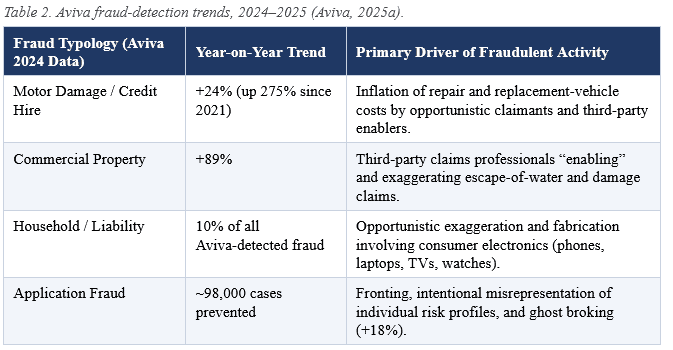
The sheer scale of exaggerated and opportunistic fraud confirms a widespread sociological issue: a significant segment of the population views defrauding an insurance company as victimless manoeuvring rather than a serious financial crime carrying severe legal consequences.
5. The Psychology of Opportunistic Fraud
To mitigate opportunistic fraud effectively, insurers must move beyond retrospective policing and address the cognitive mechanisms that enable the behaviour in the first place. The criminological framework known as the “Fraud Triangle,” developed by sociologist Donald Cressey, posits that three elements must align concurrently for fraud to occur: opportunity, pressure, and rationalisation (Cressey, 1953; Kassem & Higson, 2012).
In the current macroeconomic climate, pressure is abundant, driven by the cost-of-living crisis, stagnant wage growth, and rising inflation. Opportunity exists within digital self-service claims portals, the absence of physical inspections for minor claims, and the inherent asymmetry of information between the policyholder and the remote claims adjuster. However, it is the third pillar – rationalisation – that is most elastic and most directly governed by the level of consumer trust (Kassem & Higson, 2012).
5.1 Economic Institutions and Individual Ethics
The definitive link between institutional trust and consumer ethics was established in Sharon Tennyson’s foundational study, Economic Institutions and Individual Ethics: A Study of Consumer Attitudes Toward Insurance Fraud (Tennyson, 1997). Tennyson demonstrated that individuals’ willingness to file exaggerated claims is heavily influenced by their perception of the insurance institution’s fairness and integrity. When consumers view insurers as adversarial, overly bureaucratic, structurally unfair, or excessively profit-driven, they deploy powerful psychological defence mechanisms to neutralise the moral stigma traditionally associated with theft (Tennyson, 1997).
The rationalisation process relies heavily on the “Robin Hood” fallacy: the belief that the insurer is a wealthy, exploitative corporation and the policyholder is merely reclaiming what is rightfully theirs, or compensating themselves for years of paying premiums without a claim. If an insurer is deeply trusted, viewed as a transparent partner in risk mitigation, and perceived to operate with absolute procedural justice, the psychological friction required to commit fraud increases dramatically. Trust-building should therefore not be regarded as superficial; it is a preventative mechanism that raises the psychological cost of rationalisation. Where potential offenders cannot rationalise fraudulent behaviour, the Fraud Triangle predicts they are markedly less likely to commit it.
5.2 Behavioural Science Interventions: Dectech/IFB Empirical Studies
Recent advances in behavioural science provide robust empirical evidence that altering the psychological context of the insurance process can substantially reduce opportunistic fraud. A landmark study conducted by Decision Technology (Dectech) in collaboration with the Insurance Fraud Bureau (IFB), led by Dr Tim Mitchell and Dr Benny Cheung, tested the efficacy of behavioural “nudges” in altering consumer honesty during digital interactions (Mitchell & Cheung, 2020).
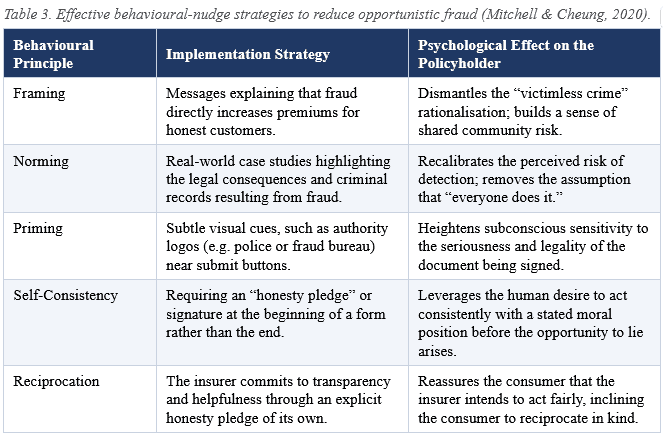
The researchers executed randomised controlled trials involving over 12,000 participants, simulating online motor insurance application and claims processes. They tested various messaging strategies designed to disrupt the rationalisation process, based on five core behavioural principles: priming (subtle cues of authority), framing (altering reference points), self-consistency (leveraging the desire to match past moral behaviour), norming (highlighting social norms and legal realities), and reciprocation (explaining the exchange of mutual favours) (Mitchell & Cheung, 2020).
The results were striking. The introduction of operational nudges – subtle pop-up messages immediately preceding the contentious questions where applicants historically lie (for example, “Have you ever been caught speeding?” or “Where is the vehicle kept overnight?”) – produced a highly statistically significant increase in honesty (Mitchell & Cheung, 2020). In the application process, these behavioural interventions prompted a 36% reduction in lying (Mitchell & Cheung, 2020).
The most effective messages directly attacked the consumer’s rationalisation framework. The top-performing “Above-the-Line” (ATL) mass-market message employed the principle of reciprocation, explicitly explaining how fraudulent claims force the insurer to raise premiums for all honest customers (Mitchell & Cheung, 2020). This direct correlation dismantled the “victimless crime” myth that underpins most opportunistic fraud. Another effective strategy employed norming, bringing the abstract concept of fraud into hard-edged reality by highlighting the severe, real-world legal consequences faced by those caught committing it, thereby rapidly recalibrating the consumer’s perceived risk/reward ratio (Mitchell & Cheung, 2020).
The Dectech study concluded that widespread, intelligent implementation of these behavioural interventions across the UK insurance sector could yield savings of between £132 million and £395 million annually (Mitchell & Cheung, 2020). These findings demonstrate that opportunistic fraud is highly elastic: it expands in environments of institutional detachment and contracts sharply when insurers proactively engage the consumer’s moral compass through transparent, context-aware communication.
6. Regulatory Catalysts: The FCA Consumer Duty and Institutional Fairness
Recognising the systemic issues of trust, opacity, and value within retail finance, the Financial Conduct Authority (FCA) has initiated a paradigm shift in regulation through the Consumer Duty. The Duty marks a definitive departure from procedural, check-box compliance toward a rigorous, outcomes-based framework. It fundamentally requires insurers to operate with transparency, consistency, and fairness, placing the burden of proof on the firm to demonstrate that its products deliver genuine value (FCA, 2023; FCA, 2026a).
The FCA’s 2025/2026 Insurance Regulatory Priorities report underscores the permanence of this shift. The regulator has explicitly mandated that “fair value” act as the primary diagnostic tool for assessing firm culture, governance, and product oversight (FCA, 2026a). Its current agenda is heavily concentrated on improving claims handling, identifying poor, delayed, or adversarial claims experiences as a primary driver of both consumer harm and structural industry distrust (FCA, 2026a).
6.1 The March 2026 Consumer Understanding Review
In March 2026, the FCA published the findings of a multi-firm review into how insurers are approaching the “consumer understanding” outcome under the Duty (FCA, 2026b). The review explicitly linked operational transparency with regulatory compliance, identifying core areas of good practice that insurers must adopt to avoid enforcement action:
- Data-driven insight identification. Insurers must move beyond superficial, cosmetic changes to their websites. Good practice involves deeply analysing multiple, cross-channel data streams – call-centre recordings, chat transcripts, formal complaints, website analytics, and form drop-off rates – to identify exactly where consumers struggle to comprehend policy terms, exclusions, or claims procedures (FCA, 2026b).
- Rigorous communication testing. Firms are now expected to use empirical methods, such as A/B testing, comprehension checks, and frontline interaction feedback, to verify that their communications are actually understood by real consumers, adapting language and processes accordingly (FCA, 2026b).
- Accessible and layered content. The FCA mandates an end to dense, legalistic jargon designed to protect the insurer at the expense of consumer comprehension. Insurers must employ clear visual hierarchies, plain language, and layered digital content, ensuring that critical information – policy exclusions, excess amounts, and risk parameters – is placed upfront, highlighted clearly, and made accessible to vulnerable customers (FCA, 2026b).
These regulatory mandates align closely with the behavioural science findings on fraud reduction. By forcing insurers to communicate clearly and eliminate hidden penalties – such as the “price-walking” loyalty penalty, where existing customers subsidise new-customer discounts – the FCA is architecting an environment in which the insurer must act as a transparent fiduciary rather than an adversarial counterparty. When policyholders clearly understand their coverage limits from inception and feel equitably treated throughout the life of the product, the cognitive dissonance required to fabricate a claim becomes far harder to sustain. Rigorous compliance with the Consumer Duty can therefore be regarded as a convincing strategy for fraud mitigation in its own right.
7. Trust Multipliers: Transparency and Explainable AI (XAI)
As insurers pivot aggressively toward digital transformation to reduce operational costs, Artificial Intelligence (AI) has become the central engine powering underwriting, dynamic pricing, telematics analysis, and fraud detection. While AI enables unprecedented efficiency – allowing straight-through claims-processing rates to rise from 15% to 80% and improving fraud-detection accuracy by over 30% (Vantage Point, 2026) – it introduces a distinct risk to consumer trust: the “black box” problem.
When an AI algorithm prices a premium, assesses a highly individualised risk, or flags a legitimate-looking claim for a protracted fraud investigation, the underlying mathematical logic and data weighting are often entirely opaque (CFA Institute, 2025; Parmar & Saran, 2025). If a consumer’s claim is denied or delayed, or their premium is inexplicably doubled by an automated system without a comprehensible human rationale, the resulting frustration breeds severe distrust. The consumer naturally assumes the machine is biased, flawed, reliant on inaccurate third-party data, or programmed explicitly to protect corporate profit margins at their expense.
7.1 The Importance of Explainable AI (XAI)
To counter this technological alienation, the industry must adopt Explainable AI (XAI). XAI refers to methodologies and techniques – such as SHapley Additive exPlanations (SHAP), Local Interpretable Model-agnostic Explanations (LIME), and counterfactual explanations – that render the outputs of complex deep-learning models interpretable and logical to human stakeholders (Parmar & Saran, 2025).
Academic research by Mullins, Holland, and Cunneen (2021), focusing on the European consumer insurance market, emphasises that ethical AI governance and algorithmic transparency are absolute prerequisites for maintaining consumer trust in the digital age (Mullins, Holland & Cunneen, 2021). Their work, closely aligned with the European Insurance and Occupational Pensions Authority (EIOPA) guidelines, stresses that algorithmic obscurity must be dismantled and that consumers must have the right to understand how their data informs pricing (Mullins, Holland & Cunneen, 2021).
Recent empirical studies conducted in 2025 on XAI and consumer trust in InsurTech pricing models demonstrate that the integration of XAI significantly improves perceived fairness, accountability, and transparency (Parmar & Saran, 2025). This correlates directly with strengthened consumer trust, increased adoption of digital insurance products, and a reduction in adversarial disputes. One 2025 study found that 56% of customers trust financial businesses significantly more when the mechanics of their AI models are explicitly explained and justified (Parmar & Saran, 2025).
In the context of fraud reduction, XAI serves a vital dual purpose. Internally, it allows human fraud investigators to validate that the AI is identifying genuine, logical fraud indicators rather than generating biased false positives based on flawed proxies (for example, postal codes acting as a proxy for socioeconomic status) (CFA Institute, 2025). Externally, when an insurer can transparently articulate exactly why a specific decision was made – providing a clear, human-readable rationale to the policyholder rather than hiding behind algorithmically generated standard terms – it reinforces institutional legitimacy. Such transparency strips away the consumer’s ability to rationalise deceit on the basis of perceived systemic unfairness or robotic bias.
8. Re-engineering the Insurer–Policyholder Dynamic: Strategic Interventions
Theoretical frameworks regarding trust, behavioural science, and fraud rationalisation are most effectively validated by observing market disruptors and forward-thinking incumbents who have embedded these principles deeply into their operational and digital models.
8.1 The Lemonade “Giveback” Model
Lemonade, a prominent InsurTech operating in the US and the UK, provides perhaps the most compelling contemporary case study of aligning behavioural economics with insurance operations to systematically remove fraud rationalisation. Operating as a Certified B-Corp, Lemonade uses a distinctive “Giveback” model. The company takes a flat, transparent percentage fee from premiums to cover its operating costs, reinsurance, and profit. The remaining pool of capital is strictly segregated and used solely to pay claims. Crucially, at the end of the year any unused money in this claims pool is not absorbed by Lemonade as profit; instead, it is donated to nonprofit organisations selected by the policyholders at the point of purchase (Lemonade, 2025b).
In 2025, Lemonade policyholders generated $2,104,557 in Giveback donations, distributed to 45 charities globally, spanning emergency response, healthcare, poverty alleviation, and climate action (Lemonade, 2025b). This financial structure represents a notable rewiring of the psychology of insurance transactions. By removing its own financial incentive to deny claims, Lemonade signals trustworthiness to its consumers.
Conversely, and critically for fraud reduction, a consumer who decides to exaggerate a claim for a stolen laptop is no longer engaging in a victimless crime against a faceless, wealthy corporation; they are explicitly and directly diverting funds from their chosen charity (for example, the American Red Cross or a local animal shelter) (Lemonade, 2025b). This mechanism harnesses behavioural science to encourage moral restraint, making the psychological cost of fraud rationalisation prohibitively high for the average consumer. The operational success of the model is evident in Lemonade’s financial trajectory: in Q3 2025 the company reported a gross loss ratio that improved significantly to 62%, demonstrating that as the customer portfolio matures and the behavioural model solidifies, claims performance and honesty improve (Lemonade, 2025a).
8.2 Usage-Based Insurance (UBI) and Data Transparency
Usage-Based Insurance (UBI), particularly in the motor sector via telematics, represents another powerful avenue for building trust through transparency and individualised pricing. By using IoT sensors and smartphone integration to monitor actual driving behaviour (speed, braking, cornering, time of day), UBI models replace broad, often discriminatory demographic proxies – such as age or postcode – with highly individualised, empirical data to determine premiums (GlobalData, 2025).
UBI inherently builds trust because it returns agency and control to the consumer. The policyholder understands exactly how their daily actions dictate their financial costs, directly addressing the CII Trust Index’s demand for “individualised risk assessment” (CII, 2025). However, the successful adoption of UBI relies heavily on impeccable data transparency. Research indicates that 27.6% of UK consumers still harbour deep data-privacy concerns regarding telematics, fearing continuous surveillance (GlobalData, 2025). Insurers that successfully deploy UBI must use XAI and clear, consistent communication to assure users that their data is secure, anonymised where necessary, and that the pricing algorithms are unequivocally fair (GlobalData, 2025). Executed correctly, UBI transforms the insurer from a passive, annual collector of premiums into an active, daily partner in risk management, shifting the adversarial dynamic toward something more co-operative.
8.3 The Shift to Proactive Service Models
The future of high-trust insurance lies in the transition from reactive indemnification (paying out after a disaster) to proactive risk mitigation and prevention (PwC, 2025). Leveraging predictive analytics, machine learning, and IoT integrations, leading insurers can now anticipate customer needs before a loss occurs.
Examples of proactive service include providing policyholders with subsidised smart-home water-leak detectors to prevent escape-of-water claims, using AI to notify customers via SMS of impending severe weather in their specific postcode, or proactively reaching out to adjust policies in response to detected life events (PwC, 2025).
When an insurer proactively acts – and spends capital – to protect a customer’s property or wellbeing, it generates goodwill and brand loyalty. The insurer demonstrates tangible, daily value outside of the stressful claims process, directly addressing the “claims gap” identified in the Fairer Finance index. A policyholder who feels their insurer is an active guardian working to safeguard their assets is highly unlikely to jeopardise that trusted relationship through petty, opportunistic fraud.
9. Conclusion: A Holistic Model for Sustainable Insurance
The assertion that trust is broken between consumers and insurers in the UK is unequivocally supported by empirical data across multiple 2025 consumer indices. The subsequent hypothesis – that the erosion of trust actively fuels the multibillion-pound epidemic of opportunistic fraud – is validated by both criminological theory and behavioural science research. Opportunistic fraud thrives in conditions of institutional opacity, perceived unfairness, economic pressure, and consumer alienation.
Materially reducing the cost of fraud therefore requires a fundamental shift. Insurers must stop treating fraud prevention solely as a reactive, post-event investigative function reliant on aggressive policing, surveillance, and penalties. Instead, fraud prevention must begin at the point of quote, engineered directly into the architecture of the customer experience through the systematic, deliberate cultivation of trust.
To achieve a sustainable balance, the industry must concurrently pull three interlocking levers:
- Transparency. Implementing Explainable AI across the value chain so that all automated decisions on pricing, underwriting, and claims are interpretable, empirically fair, and clearly communicated to the consumer without legalistic obfuscation or data asymmetries.
- Procedural consistency and fairness. Adhering strictly to the standards of the FCA Consumer Duty to eliminate predatory practices such as price-walking. Loyal customers must be actively rewarded, policy documents must be comprehensible, and all claims must be handled with rapid, predictable, and empathetic fairness.
- Human-centric innovation. Transitioning toward proactive service models and structural designs that align the financial incentives of the insurer with the moral compass of the policyholder – best demonstrated by the intelligent application of behavioural nudging in digital portals and the adoption of shared-value models such as the Lemonade Giveback.
9.1 Proposed Measurement Framework
To ensure these trust-building initiatives move beyond corporate rhetoric and yield tangible, measurable reductions in fraud and improvements in retention, insurers should adopt a holistic measurement framework that tracks both consumer sentiment and hard operational outcomes.
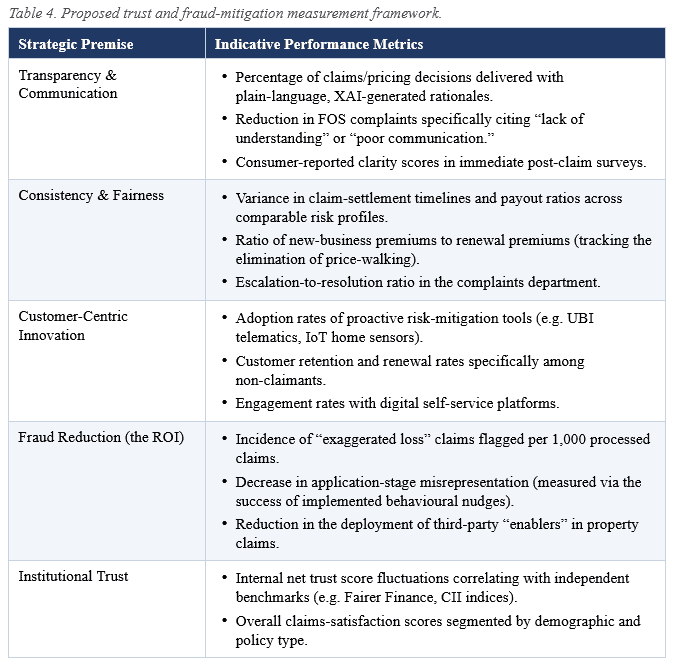
Rebuilding trust is ultimately one of the most potent, sustainable, and cost-effective counter-fraud strategies available to the modern insurer. By transforming the insurer–policyholder dynamic from one of suspicion and perceived exploitation to one of transparent, mutually beneficial partnership, the industry can dismantle the psychological justifications for fraud. In doing so, insurers will protect their honest customers, stabilise spiralling premiums, ensure rigorous regulatory compliance, and secure the long-term economic resilience of the UK insurance market.
References
Aviva (2025a) ‘Aviva detected 14% more claims fraud in 2024’. Aviva Newsroom.
Aviva (2025b) ‘Fraud on the rise but fraudsters facing the consequences’. Aviva Newsroom.
CFA Institute (2025) Explainable AI in Finance: Addressing the Needs of Diverse Stakeholders. CFA Institute.
CII (2025) Public Trust Index. Chartered Insurance Institute.
Cressey, D. R. (1953) Other People’s Money: A Study in the Social Psychology of Embezzlement. Glencoe, IL: Free Press.
Fairer Finance (2025a) The Fairer Finance Trust in Insurance Index – Spring 2025.
Fairer Finance (2025b) The Fairer Finance Trust in Insurance Index – Autumn 2025.
FCA (2023) Consumer Duty: Finalised Guidance FG22/5. Financial Conduct Authority.
FCA (2026a) Regulatory Priorities: Insurance. Financial Conduct Authority.
FCA (2026b) Multi-firm review of customer outcomes delivered by smaller mutual life insurers. Financial Conduct Authority.
GlobalData (2025) UK Insurance Consumer Survey.
Kassem, R. & Higson, A. (2012) ‘The New Fraud Triangle Model’, Journal of Emerging Trends in Economics and Management Sciences.
Lemonade (2025a) Q3 2025 Earnings Results.
Lemonade (2025b) Lemonade’s 2025 Giveback.
Mitchell, T. & Cheung, B. (2020) ‘Using behavioural science to reduce opportunistic insurance fraud’, Applied Marketing Analytics, 5(4), pp. 294–303.
Mullins, M., Holland, C. P. & Cunneen, M. (2021) ‘Creating ethics guidelines for artificial intelligence and big data analytics customers: the case of the consumer European insurance market’, Patterns, 2(10).
Parmar, D. S. & Saran, H. K. (2025) ‘Empirical Study on the Role ofa Explainable AI (XAI) in Consumer Trust’, International Journal of Computer Trends and Technology, 73(2), pp. 48–57.
PwC (2025) Insurance 2025 and Beyond. PricewaterhouseCoopers.
Tennyson, S. (1997) ‘Economic institutions and individual ethics: a study of consumer attitudes toward insurance fraud’, Journal of Economic Behavior & Organization, 32(2), pp. 247–265.
Vantage Point (2026) Insurtech Trends 2026: AI Claims Underwriting.